
The OrthoWave™
DualSync System
DualSync™ Technology — Synchronized Radial & Focused Acoustic Waves with Dynamic Tissue Activation™. Deploying through a single handpiece in one unified system.


Focused ESWT + Radial Shockwave. Synchronized in One System.
The OrthoWave DualSync™ combines Focused ESWT and Radial Shockwave into one synchronized platform — that is what DualSync™ means. Synchronized Radial & Focused Acoustic Waves deploy through a single handpiece with Dynamic Tissue Activation™, automatically during use. No switching. No separate equipment. Most competitors sell focused and radial as separate devices. The DualSync™ delivers both in every session.
Focused Acoustic Wave Technology
The DualSync™ delivers Focused ESWT through its integrated focused wave platform — generating concentrated acoustic energy for deep, targeted delivery into tissue. No separate focused handpiece required.
Dynamic Tissue Activation™
Dynamic Tissue Activation™ adds an additional energy pathway to the platform ahead of the primary shockwave settings, giving clinics a broader menu of cash-pay service options.
Precision Energy Control
With control over frequency, pressure, pulse count, session timing, and tip selection, providers can adjust how energy is delivered based on tissue depth and desired settings.
An Additional Energy Setting Applied Before Primary Delivery
Dynamic Tissue Activation™ is a lower-intensity acoustic wave setting applied before the primary shockwave sequence. It uses the same acoustic wave mechanism as the rest of the system, adjusted to a different frequency and intensity range.
Technical Function
Delivers acoustic energy at a lower intensity and different frequency range than the primary shockwave settings, applied in the sequence before them.
Settings Range
Operates within a lower-intensity band (see specs below) than the system's primary shockwave output.
Sequence Position
Used as an initial step in the overall session sequence, before the primary shockwave settings are applied.
Guided Sequences. Timed Sessions. Greater Control.
The OrthoWave DualSync System interface is designed to simplify session delivery without sacrificing control. Providers can move through guided workflows with timed sessions, settings selection by body region, recommended tip guidance, and adjustable settings for frequency, pressure, and pulse count inside a clean, modern interface.
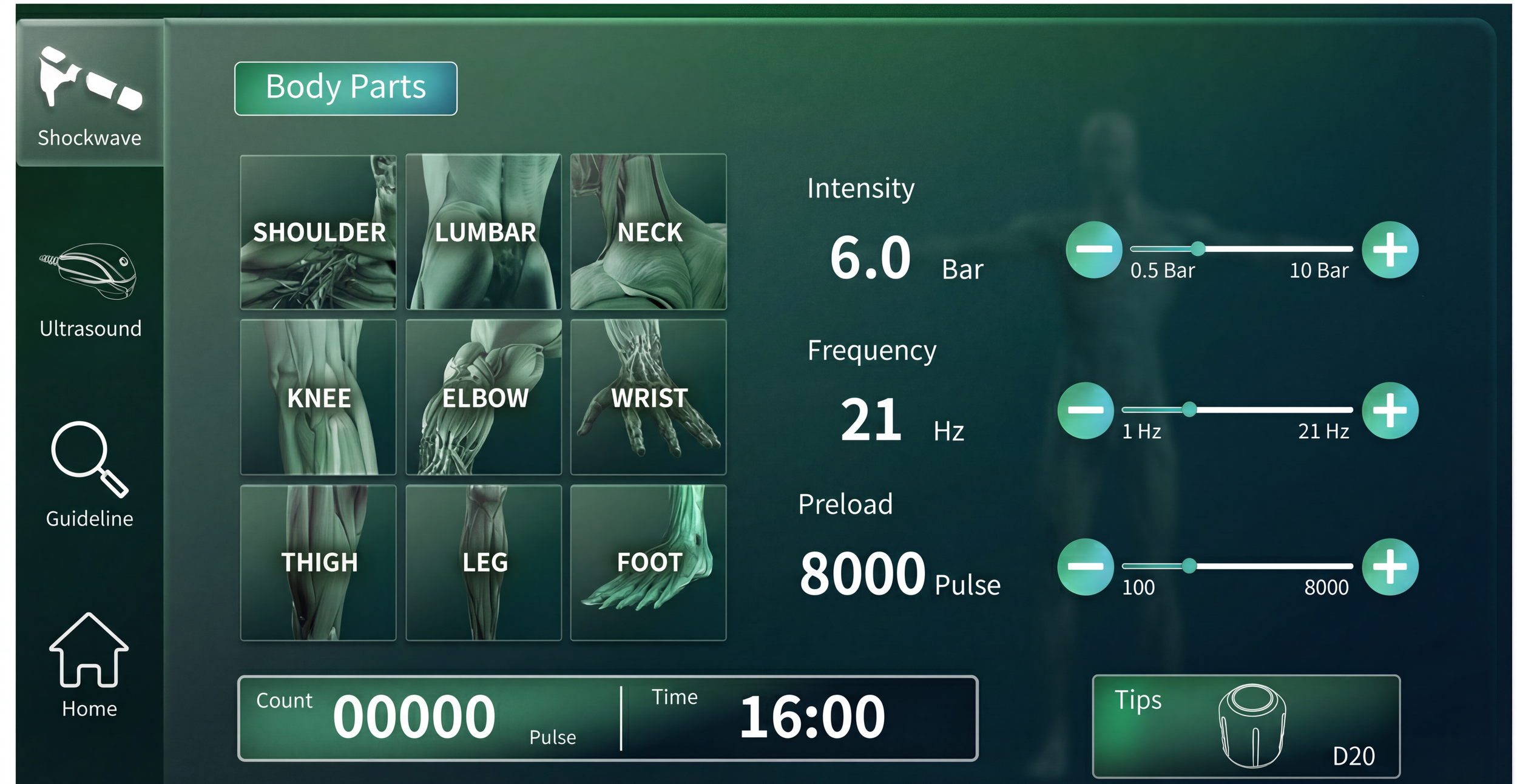
Body-Region Specific Settings
The interface organizes settings by anatomical region, making it easier to navigate options across different body areas.
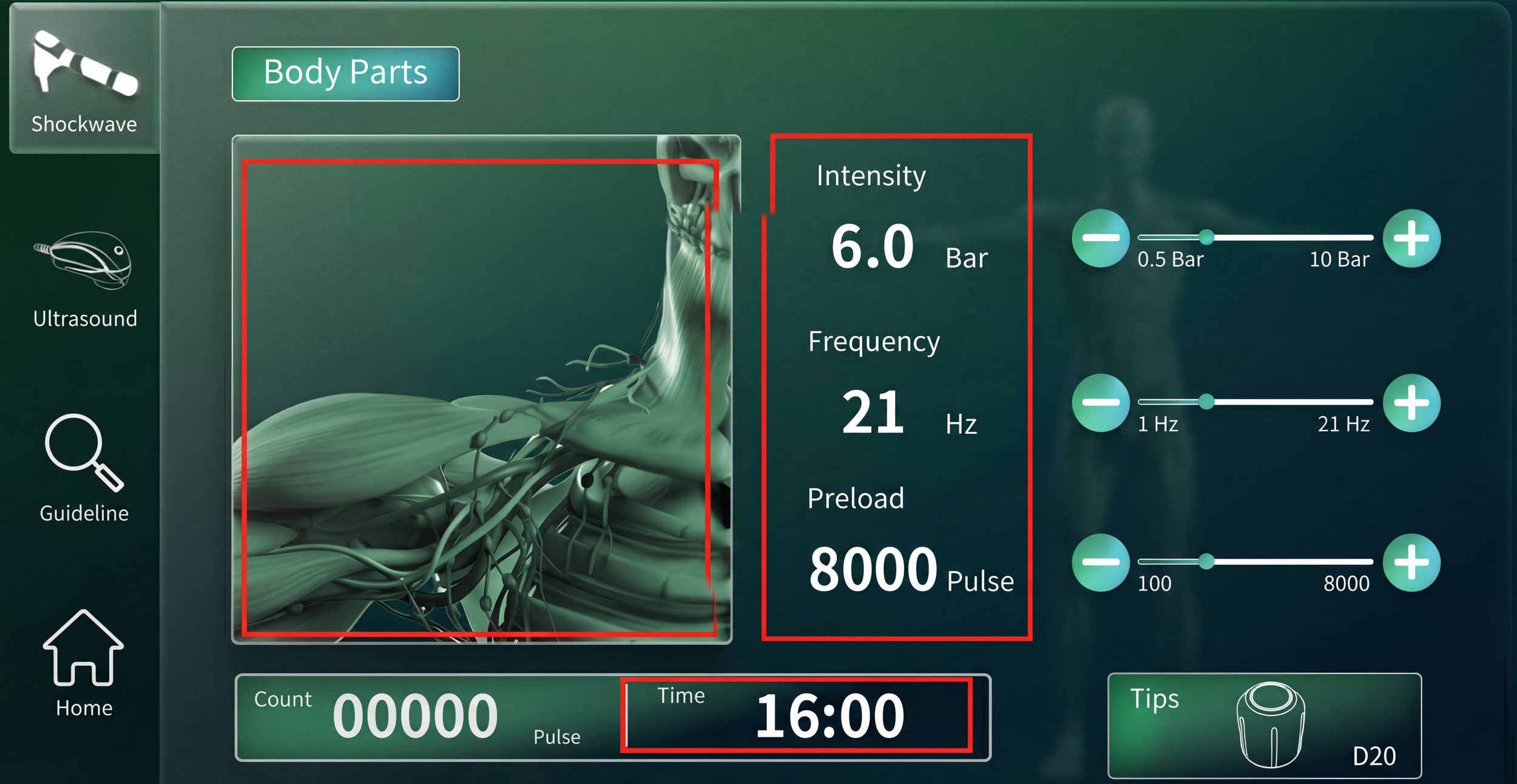
Timed Session Workflow
Sessions are timed directly within the system, helping providers deliver consistent, structured use.
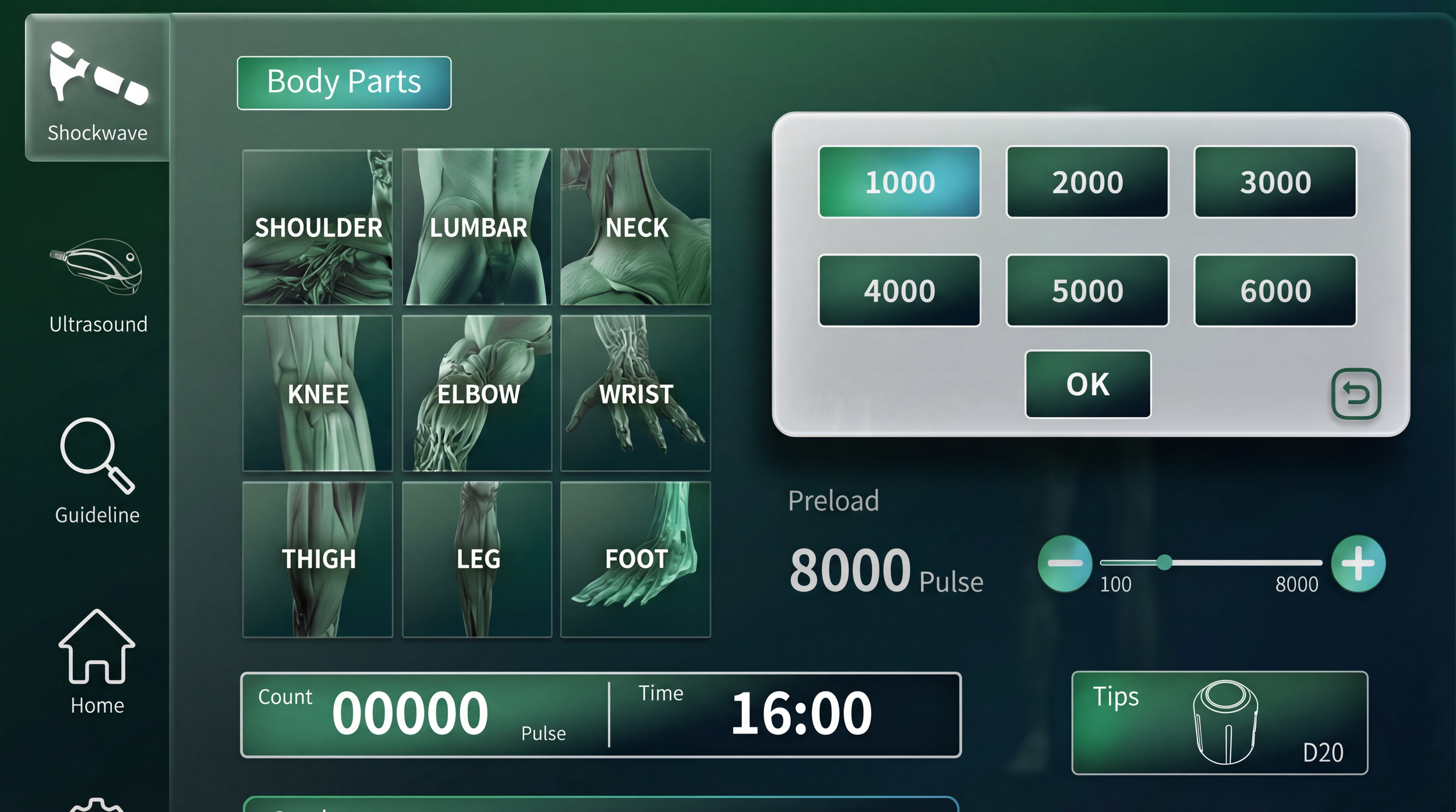
Tip Guidance & Setting Control
The system helps guide tip selection while giving providers control over frequency, pressure, and pulse count for a more precise setup.
Focused ESWT. Radial Shockwave. Dynamic Tissue Activation™.
The DualSync™ name says exactly what it is — Dual, meaning Focused ESWT and Radial Shockwave, and Sync, meaning both deploy through one handpiece simultaneously. Focused Acoustic Waves handle deep, concentrated, targeted delivery. Radial Acoustic Waves handle broad coverage, fascia, and large muscle groups. The system manages the delivery automatically.
Radial Acoustic Waves
Up to 10 bar and 21 Hz through the handpiece. Suited for broad tissue coverage, fascia, muscle belly, and large musculoskeletal regions.
Focused Acoustic Waves
Concentrated acoustic energy for deep, targeted structural delivery. Both focused energy pathways are built in — no additional handpiece needed.
Tip-Driven Performance
The machine is the engine, but the tip determines how energy behaves — allowing providers to shift between broader and more targeted delivery styles inside one platform.
Frequency Controls Speed. Pressure Controls Impact.
OrthoWave is not just a device — it is a controllable energy platform. Providers can adjust both frequency and pressure to determine how energy is delivered into tissue, allowing for a range of settings from more superficial applications to deeper energy delivery depending on the desired setup.
Frequency (Hz)
Frequency controls how fast pulses are delivered. Lower frequencies allow more effect per pulse and are typically used for deeper tissue interaction, while higher frequencies are used for more superficial or sensitive-area settings.
Pressure (Bar)
Pressure controls how much force each pulse delivers. Higher pressure is used for dense tissue and deeper structures, while lower pressure supports more surface-level use.
Setting Pairing
In general, lower Hz pairs with higher bar for deeper energy delivery, while higher Hz pairs with lower bar for more superficial settings or sensitive regions.
Built for a Cash-Pay Practice Model
One of the biggest advantages of the OrthoWave DualSync System is that it gives practices a flexible, single-platform setup. With Focused ESWT + Radial Shockwave and Dynamic Tissue Activation™, clinics can build a cash-pay service offering around one system rather than several separate devices.
Better Case Presentation
The system gives providers a modern, differentiated story to present to patients about the technology being used.
Broader Revenue Opportunities
Clinics can build premium cash-pay plans around advanced shockwave technology, alongside their existing services.
Higher-End Positioning
A more advanced device, cleaner interface, and broader capability help position the practice as technology-forward and differentiated.
One System, Multiple Applications
Designed for providers who want a flagship platform that can support use across multiple specialties and settings inside one system.
